
How We Work Together
Research works best when it’s practical, collaborative, and connected to real business decisions.
Some brands come in with a specific challenge, while others simply want a clearer picture of what their customers are experiencing and where the biggest opportunities exist.
We start with a focused project, learn what matters most, and build from there based on what proves useful.

1. Start Small
Begin with a focused project
Understand your business, customers, and priorities
Build context around the decisions you’re trying to make
Identify where research can have the most impact
Establish a collaborative working rhythm
Goal: Create a strong starting point, learn what’s most useful, and build momentum without overcomplicating the process.
2. Learn What Matters
Turn customer understanding into clearer direction
Surface patterns, friction points, and customer motivations
Learn from real customer experiences and real-world use
Reduce uncertainty around important decisions
Clarify priorities and opportunities for improvement
Goal: Move beyond assumptions and gut instinct toward clearer, more confident decision-making.
3. Build From There
Expand understanding over time
Continue exploring questions that matter to the business
Refine products, customer experiences, or messaging
Test ideas before committing significant time or resources
Develop more consistent ways of learning from customers over time
Goal: Scale research based on your priorities, your pace, and what proves most useful for the business.

Tools for the Job
Research with Scouted Path is designed to be practical, decision-ready, and easy to integrate into how your business already works.
Research helps uncover the motivations, behaviors, and friction points shaping customer decisions, replacing guesswork with understanding and assumptions with evidence.
The methods below provide a strong foundation while allowing research to adapt to your goals, customers, and business context.

Journey Mapping – Identify pain points in the customer experience from discovery to purchase to use.

Surveys & Interviews – Understand customer attitudes, behaviors, preferences, and pain points.

Usability Testing – Evaluate websites and apps, products and gear, services and experiences.

Field Research – Observe and analyze customers interacting with products and services in real-world environments.
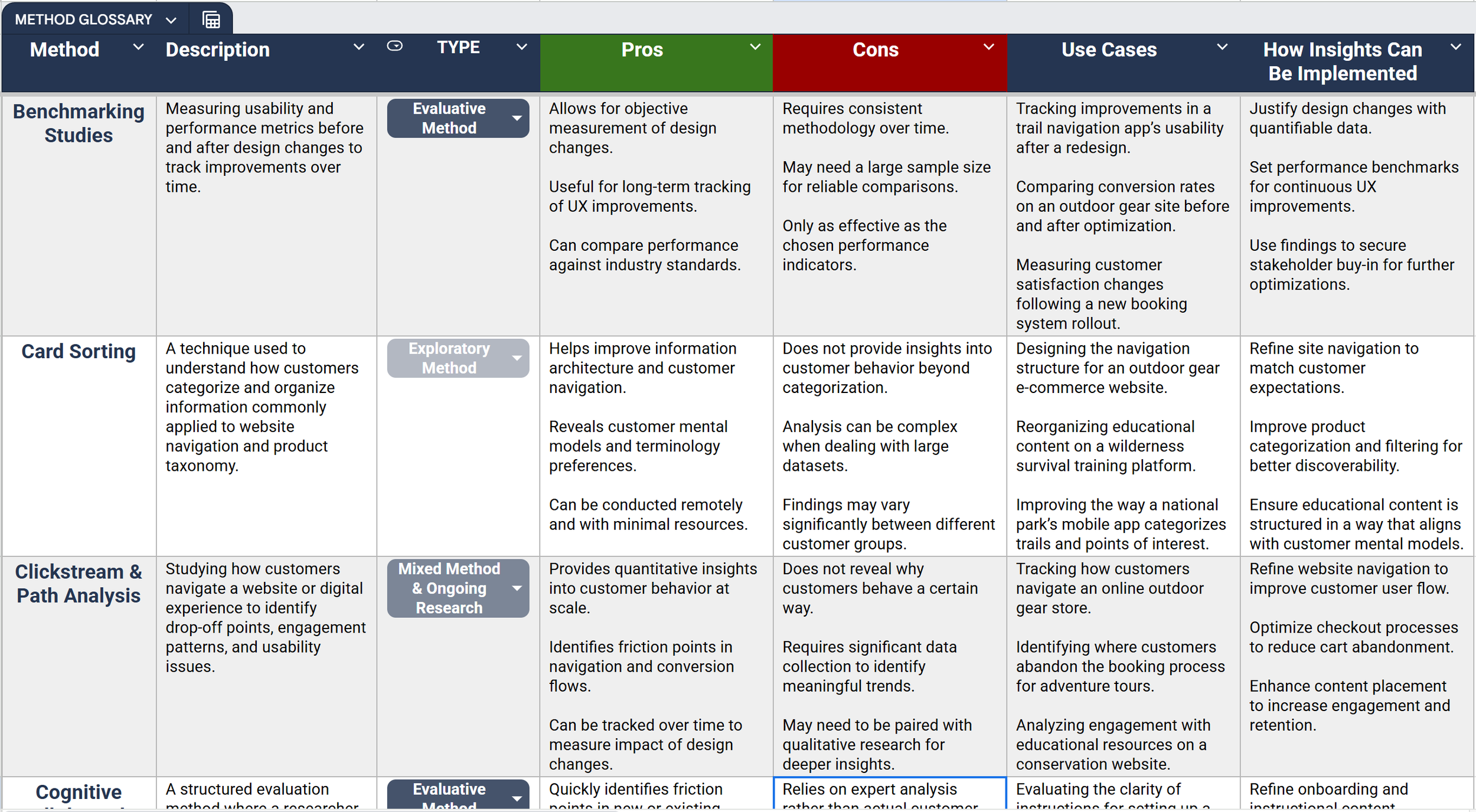
Methods Glossary
Methods can be adapted and combined based on the goals of the project, the decisions being explored, and the realities of the business.
The glossary below provides a broader look at research methods and approaches, including real-world use cases, strengths, limitations, and outdoor industry applications.
Explore the full Methods Glossary →